About Board Certification in Orthodontics
Choosing an orthodontist is a big decision, and understanding what board certification means can help you feel confident in your choice. While every orthodontist must complete specialized training and be licensed to practice, not all orthodontists take the extra step to become Board Certified by the American Board of Orthodontics (ABO). Board certification represents a higher level of dedication, clinical excellence, and ongoing commitment to advancing the quality of orthodontic care.
The following guide explains what board certification is, how orthodontists earn it, and why it matters for patients seeking the highest standard of treatment.
Are All Orthodontists Board Certified?
No. All orthodontists are required to be licensed, but only a portion choose to pursue additional certification through the American Board of Orthodontics. In fact, fewer than half of orthodontists complete the rigorous steps needed to become board-certified.
The ABO certification process is a significant achievement that goes far beyond the two to three years of advanced residency training required to become an orthodontic specialist. To earn certification, orthodontists must:
- Submit detailed case reports demonstrating clinical excellence
- Present a broad range of treated cases
- Show mastery in diagnosis, treatment planning, and clinical execution
- Undergo a thorough examination and interview with an expert panel
Board certification is voluntary, but those who complete the process demonstrate a strong commitment to excellence, lifelong learning, and the highest standard of patient care.
How Many Certifying Boards Are Recognized by the American Dental Association in the Specialty of Orthodontics?
Only one.
The American Board of Orthodontics is the sole ADA-recognized certifying board in the specialty of orthodontics. Founded in 1929, it is the oldest specialty board in the dental profession and remains the gold standard for orthodontic certification.
The ABO’s mission is to elevate the quality of orthodontic care through:
- Certification
- Ongoing education
- Professional collaboration
- Setting high standards for clinical practice
For patients, this means that choosing a board-certified orthodontist ensures you are being treated by a doctor who has met the highest nationally recognized requirements in orthodontics.
Why Would an Orthodontist Choose to Complete This Voluntary Certification Process?
Orthodontists pursue board certification for one primary reason: excellence.
Completing the ABO certification process is a clear demonstration of an orthodontist’s dedication to:
- The highest level of clinical competency
- Delivering exceptional patient care
- Staying current with the latest advancements in orthodontics
- Upholding rigorous, evidence-based treatment standards
Board certification reflects a practitioner’s personal and professional commitment to continued learning. Since orthodontics is a rapidly evolving field, with innovations in aligners, digital imaging, treatment planning, and biomechanics, board-certified orthodontists regularly update their skills to maintain the most modern, effective treatment techniques.
For patients, this means peace of mind knowing that your orthodontist is dedicated to providing the very best level of care available.
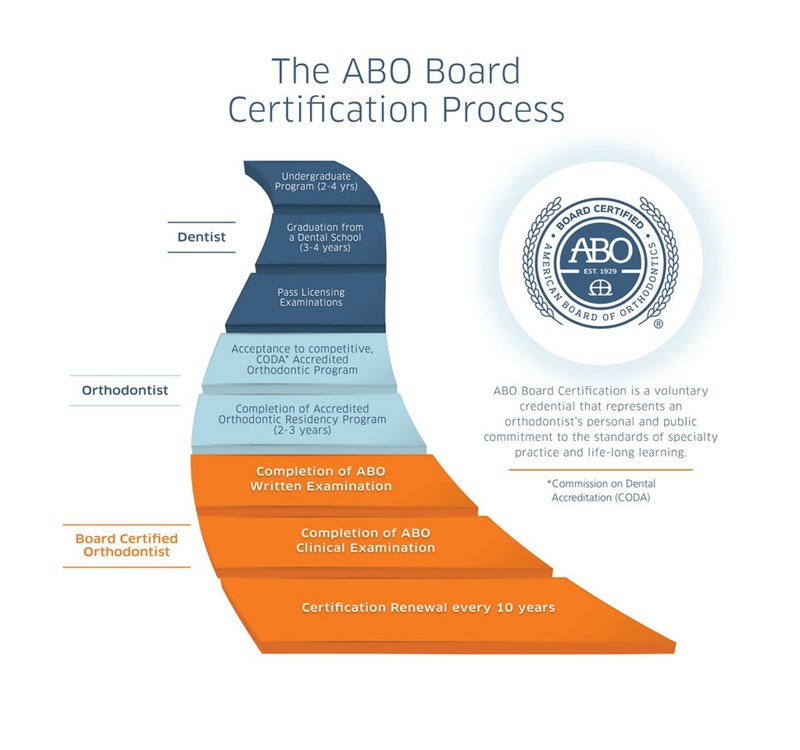
What is the ABO Certification Process?
Becoming a board-certified orthodontist requires successfully completing several rigorous phases designed to evaluate both academic knowledge and real-world clinical skills.
1. Written Examination
The first step evaluates an orthodontist’s core knowledge in orthodontic principles, diagnosis, growth and development, biomechanics, treatment planning, and related sciences. This exam confirms that the doctor has a strong theoretical foundation in modern orthodontics.
2. Clinical Examination (Scenario-Based Format)
Next, the orthodontist completes a scenario-based clinical exam using real case examples. This assessment measures the doctor’s ability to diagnose, plan, implement, and evaluate orthodontic treatment while demonstrating sound clinical judgment. It ensures they can deliver high-quality, personalized, and effective care.
3. Certification Achievement
Once both the written and clinical examinations are passed, the orthodontist earns the distinction of becoming a Board-Certified Orthodontist. This national certification is a significant professional accomplishment. Because standards evolve over time, certification is time-limited and must be renewed to ensure orthodontists remain current with the latest advances in the specialty.
4. Certification Renewal
ABO certification is valid for ten years. To stay actively certified, orthodontists must complete a renewal examination or meet other requirements recognized by the ABO. This process helps ensure that board-certified orthodontists consistently maintain the highest level of clinical excellence.